


Energy drinks are widely consumed by students, athletes, professionals, and people who need an extra boost of energy during busy days. However, questions about their effects on cardiovascular health have attracted increasing attention from researchers. The American Heart Association energy drink study is particularly important because research published in the Journal of the American Heart Association found that consuming large amounts of energy drinks could affect heart rhythm and blood pressure, even in otherwise healthy young adults.
More recent research has continued to investigate these concerns. In 2026, the American Heart Association highlighted additional findings involving energy drinks, stimulant supplements, and reported cardiovascular emergencies. Understanding these studies can help consumers make informed decisions about caffeine intake and recognize the potential risks associated with excessive energy drink consumption.
What Is the American Heart Association Energy Drink Study?
The American Heart Association energy drink study commonly refers to a randomized clinical trial published in 2019 in the Journal of the American Heart Association. Researchers investigated how consuming large quantities of commercially available energy drinks affected the electrical activity of the heart and blood pressure.
The study attracted attention because energy drinks had become increasingly popular, particularly among young adults. Although these products were marketed as convenient ways to improve alertness and physical performance, researchers wanted to understand whether their ingredients could produce measurable cardiovascular changes.
The research involved 34 healthy volunteers between 18 and 40 years old. Participants consumed two different commercially available energy drinks and a placebo on separate study days.
Researchers monitored several cardiovascular measurements to identify differences between the drinks and the placebo.
The main findings suggested that consuming 32 ounces of energy drinks within one hour could temporarily affect:
- The heart’s electrical activity.
- The QT interval, which measures part of the heart’s electrical recovery process.
- Systolic and diastolic blood pressure.
- Other electrocardiographic measurements.
The findings raised concerns about consuming large quantities of energy drinks over a short period.
Importantly, the research did not establish that every energy drink causes heart disease. It demonstrated measurable short-term cardiovascular effects under specific experimental conditions.
What Did the American Heart Association Energy Drink Research Discover?
The 2019 clinical trial provided several important findings about the relationship between energy drink consumption and cardiovascular function.
1. Energy Drinks Can Affect Heart Rhythm
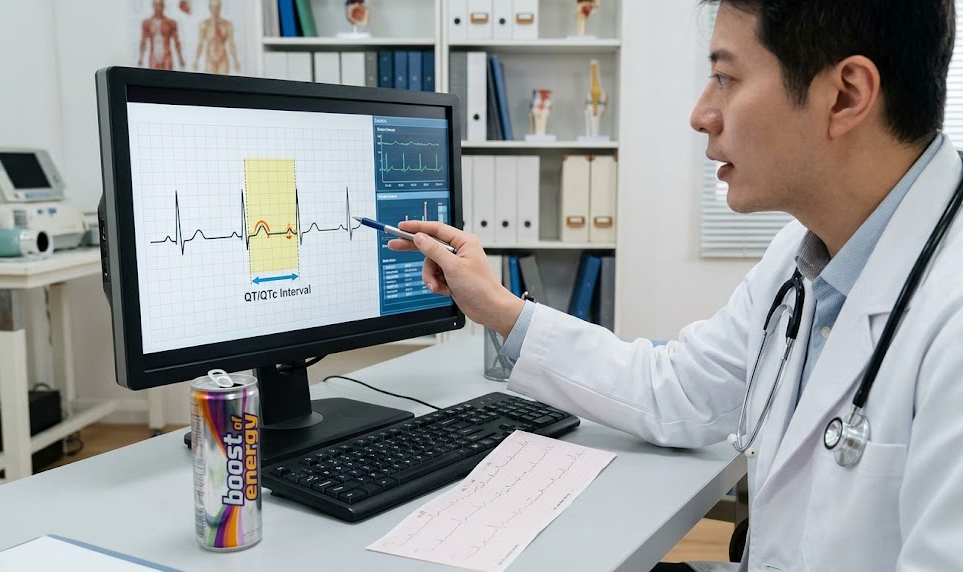
One of the most important findings involved the QTc interval.
The QT interval represents the time required for the heart’s lower chambers to electrically activate and recover before the next heartbeat. The QTc interval is adjusted for heart rate, making it easier for researchers to compare measurements.
When this interval becomes prolonged, it can indicate changes in the heart’s electrical activity. Significant QT prolongation can increase susceptibility to certain dangerous abnormal heart rhythms.
In the 2019 study, researchers observed changes in corrected QT intervals following energy drink consumption.
The findings suggested that the two tested energy drinks affected cardiac electrical activity differently from the placebo.
However, a temporary change in QTc does not automatically mean someone will develop an arrhythmia. It is a measurable cardiovascular response that deserves further investigation.
2. Blood Pressure Increased After Consumption
Another important discovery involved blood pressure.
Researchers found statistically significant differences in peripheral and central blood pressure measurements between the energy drink groups and the placebo group.
Blood pressure measures the force exerted by circulating blood against artery walls.
Two main measurements are used:
- Systolic blood pressure: The pressure when the heart contracts.
- Diastolic blood pressure: The pressure when the heart relaxes between beats.
An increase in either measurement can be important, particularly for individuals who already have elevated blood pressure.
The research demonstrated that large-volume energy drink consumption could temporarily influence these measurements.
3. Cardiovascular Changes Were Observed in Healthy Participants
The study included healthy young adults rather than people specifically diagnosed with cardiovascular disease.
This detail is important because it shows that the observed changes were not limited to participants with known heart conditions.
However, researchers did not establish how the same products would affect older adults, children, people with hypertension, or individuals with existing heart problems.
The results therefore highlight a potential concern without establishing the level of risk for every population.
4. Different Energy Drinks Produced Different Results
Researchers tested two commercially available energy drinks rather than relying on a single product.
Both products produced changes in cardiovascular measurements.
The results also demonstrated that energy drinks should not automatically be treated as identical products. Their caffeine concentrations, additional ingredients, and serving sizes can differ considerably.
This makes it important for consumers to examine product labels rather than assuming that all energy drinks have similar effects.
How Was the 2019 Energy Drink Study Conducted?
Understanding the research method helps explain why its findings attracted attention.
The study used a randomized, double-masked, placebo-controlled crossover design.
This means participants received different study beverages on separate occasions, allowing researchers to compare cardiovascular responses within the same group.
Study Participants
The research included 34 healthy volunteers.
Their average age was approximately 22 years, placing most participants in the young-adult category.
The researchers selected this population to investigate how energy drinks affected people without known cardiovascular disease.
Energy Drink Consumption
Participants consumed 32 ounces of one of two commercial energy drinks within 60 minutes.
They also consumed a placebo during a separate study session.
The three study sessions were separated by six-day washout periods.
A washout period helps reduce the possibility that effects from an earlier study session will influence measurements during the next session.
Health Measurements
Researchers monitored participants before and after consuming the beverages.
Measurements were taken every 30 minutes over four hours.
The main measurements included:
| Measurement | What It Evaluates |
|---|---|
| QTc interval | Electrical recovery of the heart |
| QT interval | Electrical activity during ventricular contraction and recovery |
| PR interval | Electrical signal transmission from the atria to the ventricles |
| QRS duration | Electrical activation of the ventricles |
| Heart rate | Number of heartbeats per minute |
| Systolic pressure | Pressure during heart contraction |
| Diastolic pressure | Pressure between heartbeats |
This approach allowed researchers to identify short-term changes in cardiovascular function.
What Is the Connection Between Caffeine and Heart Health?
Caffeine is one of the primary ingredients responsible for the stimulating effects of energy drinks.
It works mainly by blocking adenosine receptors in the brain. Adenosine is involved in regulating sleepiness, so blocking its activity can increase alertness and reduce the sensation of fatigue.
However, caffeine also affects other body systems, including the cardiovascular system.
Caffeine and Blood Pressure
Caffeine can temporarily increase blood pressure in some individuals.
The size of the response depends on several factors, including:
- The amount of caffeine consumed.
- Individual caffeine sensitivity.
- Regular caffeine consumption.
- Age and general health.
- Existing cardiovascular conditions.
People who rarely consume caffeine may experience a more noticeable response than habitual consumers.
Caffeine and Heart Rate
Caffeine can influence cardiovascular activity, but its effects on heart rate are not identical for everyone.
Some people experience palpitations or a noticeable increase in heartbeat after consuming energy drinks.
Others may experience little noticeable change.
It is important to distinguish between the sensation of a faster heartbeat, measurable changes in heart rate, and clinically significant abnormal heart rhythms.
These are related but different conditions.
Other Ingredients in Energy Drinks
Energy drinks frequently contain additional ingredients alongside caffeine.
Common examples include:
- Taurine.
- Guarana.
- B vitamins.
- Ginseng.
- Sugar or artificial sweeteners.
- Other plant-based stimulant ingredients.
Guarana is particularly relevant because it naturally contains caffeine. Consumers who do not recognize this ingredient may underestimate the total stimulant content of a product.
Researchers are still investigating how combinations of ingredients influence cardiovascular responses.
New American Heart Association Energy Drink Findings in 2026
Research into energy drinks has continued beyond the widely discussed 2019 clinical trial.
On November 2, 2026, the American Heart Association highlighted preliminary research examining adverse-event reports involving caffeinated energy drinks and stimulant-containing dietary supplements.
The research was scheduled for presentation at the American Heart Association Scientific Sessions 2026.
Unlike the 2019 controlled clinical trial, this investigation examined reports submitted to a government safety database.
What Did the 2026 Research Examine?
Researchers reviewed 28,345 adverse-event reports submitted to the US Food and Drug Administration between 2017 and 2025.
Of these reports:
- 854 involved caffeine or stimulant-containing energy drinks and dietary supplements.
- 27,491 involved products without caffeine or other stimulants.
Researchers compared the types of reported health problems associated with these product categories.
Important Findings
The analysis identified several notable patterns:
- Cardiac arrest: Reports involving cardiac arrest appeared approximately 11 times more often in connection with caffeine- and stimulant-containing products.
- Heart attacks: Reports involving these products were approximately 4.5 times more likely to include heart attacks.
- Abnormal heart rhythms: Reports were approximately four times more likely to include ventricular arrhythmias or heart palpitations.
Researchers also highlighted concerns involving adults between 18 and 34 years old.
These findings are important because young adults are not generally considered a high-risk population for many cardiovascular emergencies.
Does the 2026 Research Prove Energy Drinks Cause Heart Attacks?
No.
This distinction is essential when interpreting the findings.
The research analyzed voluntarily submitted adverse-event reports. It did not track every person who consumed energy drinks or establish how many people experienced cardiovascular problems after consumption.
It also could not prove that the products directly caused the reported events.
Other factors, including underlying health conditions, additional stimulant use, medications, and lifestyle habits, could have influenced the outcomes.
Furthermore, the findings were presented as a research abstract rather than a completed peer-reviewed journal publication.
The results should therefore be considered preliminary evidence that supports further investigation, not definitive proof of causation.
How Much Caffeine Is Safe to Consume?
Caffeine intake is an important consideration when evaluating the potential risks of energy drinks.
According to the American Heart Association’s 2026 scientific statement on caffeine and cardiovascular disease, consuming up to 400 milligrams of caffeine daily is generally considered safe for most healthy adults.
However, this recommendation should not be interpreted as permission to consume 400 milligrams from energy drinks.
The cardiovascular effects of caffeine can vary depending on its source, concentration, and accompanying ingredients.
Understanding Caffeine Content
Different beverages contain different quantities of caffeine.
| Beverage | Typical Caffeine Considerations |
|---|---|
| Regular brewed coffee | Often contains substantial caffeine per serving |
| Black tea | Usually contains less caffeine than brewed coffee |
| Soft drinks | Generally contain lower caffeine amounts |
| Energy drinks | Caffeine content varies significantly by product |
| Energy shots | Can contain highly concentrated caffeine |
Actual amounts depend on serving size, preparation method, and manufacturer formulation.
Consumers should check the nutrition label and caffeine information before drinking these products.
Why the 400 mg Recommendation Does Not Apply Equally to Everyone
The 400 mg daily guideline is intended for most healthy adults, not every individual.
Some people may need to consume considerably less caffeine.
This includes individuals who:
- Have high blood pressure.
- Experience heart palpitations.
- Have certain heart rhythm disorders.
- Are particularly sensitive to caffeine.
- Take medications that interact with stimulants.
- Have been advised by a healthcare professional to restrict caffeine.
Children and teenagers should avoid energy drinks because of their potential cardiovascular and other health effects.
Pregnant individuals should also follow pregnancy-specific caffeine guidance from their healthcare professionals.
Potential Health Risks of Drinking Too Many Energy Drinks
Energy drinks can produce several unwanted effects, particularly when consumed in large quantities or combined with other stimulants.
1. Increased Blood Pressure
High caffeine intake can temporarily increase blood pressure.
People with existing hypertension may be particularly vulnerable to this effect.
Repeated exposure to excessive caffeine may also complicate blood pressure management.
2. Irregular Heartbeat
Some individuals experience palpitations after consuming energy drinks.
In certain circumstances, stimulant exposure may contribute to abnormal electrical activity in the heart.
People with underlying rhythm disorders should be especially cautious.
3. Sleep Disruption
Caffeine can interfere with the body’s natural sleep process.
Drinking energy drinks late in the afternoon or evening may make it harder to fall asleep.
Poor sleep can affect concentration, mood, and overall health.
4. Anxiety and Nervousness
High caffeine intake may cause symptoms such as:
- Restlessness.
- Nervousness.
- Shakiness.
- Irritability.
- Difficulty concentrating.
These effects can become more noticeable in people who are sensitive to stimulants.
5. Excessive Sugar Consumption
Many traditional energy drinks contain substantial amounts of added sugar.
Regularly consuming sugary beverages can make it more difficult to maintain a balanced diet.
Excessive added sugar intake is associated with several long-term health concerns, including weight gain and an increased risk of metabolic problems.
Sugar-free energy drinks remove much of this sugar-related concern, but they do not eliminate the potential cardiovascular effects of caffeine and other stimulants.
Are Sugar-Free Energy Drinks Safer for the Heart?
Sugar-free energy drinks are often marketed as healthier alternatives to traditional products.
They generally contain little or no added sugar, which can help reduce overall sugar consumption.
However, sugar-free does not necessarily mean heart-safe.
These products may still contain:
- High amounts of caffeine.
- Guarana and other caffeine-containing ingredients.
- Additional stimulants.
- Other compounds that can affect cardiovascular function.
The 2019 American Heart Association journal study investigated the effects of energy drinks as complete formulations. It did not establish that removing sugar eliminates the cardiovascular effects associated with these beverages.
Therefore, consumers should evaluate both sugar content and stimulant ingredients.
Energy Drinks vs. Coffee: Which Is Better for Heart Health?
Energy drinks and coffee both contain caffeine, but they are not interchangeable from a cardiovascular research perspective.
The American Heart Association’s 2026 scientific statement emphasized that evidence about moderate coffee consumption should not automatically be applied to energy drinks.
Coffee contains naturally occurring compounds that may contribute to its observed health associations.
Energy drinks, on the other hand, frequently combine caffeine with other ingredients and may deliver large quantities of stimulants in a relatively short period.
| Feature | Coffee | Energy Drinks |
|---|---|---|
| Main stimulant | Caffeine | Usually caffeine |
| Additional ingredients | Naturally occurring coffee compounds | May contain taurine, guarana, and other additives |
| Sugar content | Depends on preparation | Varies by product |
| Cardiovascular research | Extensive research available | More research needed |
| Potential effects | Depends on amount and individual response | May affect blood pressure and heart rhythm |
| Serving size | Varies | Often sold in larger or concentrated servings |
For most healthy adults, moderate consumption of plain caffeinated coffee can fit within current cardiovascular guidance.
However, high-caffeine energy drinks and energy shots deserve greater caution.
The key is to evaluate the complete beverage rather than looking only at its caffeine content.
Who Should Avoid or Limit Energy Drinks?
Although energy drinks are widely available, they are not appropriate for everyone.
Certain groups should avoid them or discuss caffeine intake with a healthcare professional.
Children and Teenagers
Young people may be more vulnerable to the effects of high caffeine intake.
Energy drinks can also interfere with sleep and may encourage excessive stimulant consumption.
People With High Blood Pressure
Individuals with hypertension should be cautious because caffeine can temporarily increase blood pressure.
People With Existing Heart Conditions
Those with abnormal heart rhythms, congenital heart conditions, or other cardiovascular disorders should seek medical advice before consuming stimulant-containing products.
Pregnant Individuals
Pregnant individuals should follow established pregnancy-specific caffeine limits and avoid energy drinks unless their healthcare professional advises otherwise.
People Who Combine Multiple Stimulants
Combining energy drinks with pre-workout supplements, caffeine pills, or other stimulant-containing products can increase total stimulant exposure.
This practice may increase the likelihood of unwanted cardiovascular effects.
How to Reduce the Potential Risks of Energy Drinks
Consumers who want to improve their energy levels without excessive stimulant exposure can make several practical changes.
1. Check the Caffeine Label
Always examine the caffeine content per serving.
Some containers contain multiple servings, meaning the total caffeine intake can be higher than expected.
2. Avoid Drinking Multiple Energy Drinks Together
Consuming several energy drinks within a short period can lead to excessive caffeine exposure.
Avoid treating these beverages as ordinary soft drinks.
3. Do Not Combine Energy Drinks With Other Stimulants
Be cautious about combining energy drinks with caffeine supplements, pre-workout products, or stimulant medications.
Ask a healthcare professional about possible interactions.
4. Avoid Late-Day Consumption
Caffeine can remain active in the body for several hours.
Limiting consumption later in the day may help protect sleep quality.
5. Choose Better Hydration Habits
Water is generally a better everyday hydration choice.
For routine physical activity, most people do not need highly caffeinated energy drinks.
6. Pay Attention to Warning Symptoms
Stop consuming the product if you experience unusual palpitations, dizziness, or significant discomfort.
Seek emergency medical attention if you develop chest pain, fainting, severe shortness of breath, or a sustained rapid or irregular heartbeat.
Do not assume that serious symptoms will disappear without medical evaluation.
What Does the Research Mean for Everyday Energy Drink Consumers?
The American Heart Association energy drink study provides useful information for anyone who regularly consumes caffeinated beverages.
Its findings do not mean that every person who drinks an energy drink will experience cardiovascular problems.
Instead, the research highlights why serving size, caffeine concentration, individual health conditions, and additional stimulant ingredients matter.
The 2019 randomized trial demonstrated measurable changes in heart rhythm and blood pressure after high-volume energy drink consumption.
The preliminary 2026 research added another layer of concern by identifying disproportionate reporting of serious cardiovascular events involving stimulant-containing products.
Together, these findings support a cautious approach.
Consumers should avoid excessive caffeine intake, understand the ingredients in their beverages, and consider their individual health circumstances.
For people who depend on energy drinks every day, it may also be worth investigating the underlying reason for persistent tiredness. Poor sleep, inadequate nutrition, dehydration, and other health issues can contribute to low energy.
Addressing these factors may provide a more sustainable solution than repeatedly increasing stimulant consumption.
Conclusion
The American Heart Association energy drink study highlights important questions about the relationship between high-volume energy drink consumption and cardiovascular health. Research published in 2019 found that consuming 32 ounces of energy drinks within one hour could temporarily affect heart rhythm measurements and blood pressure in healthy young adults.
More recent research presented in 2026 has raised additional concerns about reported cardiac emergencies involving energy drinks and stimulant supplements. However, these preliminary findings do not establish direct causation.
The most important takeaway is that energy drinks should not be treated as harmless alternatives to ordinary beverages. Understanding caffeine content, avoiding excessive consumption, and considering individual cardiovascular health can help consumers make safer decisions.
For anyone experiencing unusual heart symptoms after consuming an energy drink, professional medical evaluation is more important than simply switching brands.
Frequently Asked Questions (FAQs)
1. What Did the American Heart Association Energy Drink Study Find?
The 2019 study found that consuming 32 ounces of energy drinks within one hour significantly affected certain heart rhythm measurements and blood pressure in healthy young adults. Researchers concluded that high-volume energy drink consumption could produce measurable cardiovascular changes.
2. Can Energy Drinks Cause Heart Problems?
Energy drinks may affect blood pressure and the heart’s electrical activity, particularly when consumed in large quantities. Research has also identified concerns involving abnormal heart rhythms. However, individual risk varies, and not every consumer will experience cardiovascular problems.
3. How Much Caffeine Is Safe According to the American Heart Association?
The American Heart Association’s 2026 scientific statement indicates that up to 400 milligrams of caffeine daily is generally safe for most healthy adults. However, individual tolerance varies, and this amount should not be treated as a recommended energy drink allowance.
4. Are Sugar-Free Energy Drinks Better for Heart Health?
Sugar-free energy drinks contain less added sugar, which can be beneficial for reducing sugar consumption. However, they may still contain substantial caffeine and other stimulants. Removing sugar does not eliminate potential cardiovascular risks.
5. Can Energy Drinks Increase Blood Pressure?
Yes. Clinical research has found that high-volume energy drink consumption can increase blood pressure. People with existing hypertension may be particularly sensitive to these effects.
6. Should Teenagers Drink Energy Drinks?
No. Energy drinks are not recommended for children and teenagers because of their potential effects on cardiovascular function, sleep, and overall health. Water and balanced nutrition are better everyday choices.
7. Does the 2026 American Heart Association Research Prove Energy Drinks Cause Heart Attacks?
No. The 2026 research identified an association between stimulant-containing products and serious cardiovascular events reported to the FDA. Because the analysis relied on voluntary adverse-event reports, it cannot establish that energy drinks directly caused heart attacks or cardiac arrest.
Enjoyed reading this article? There’s more to explore! Click Read More for more interesting stories.
